


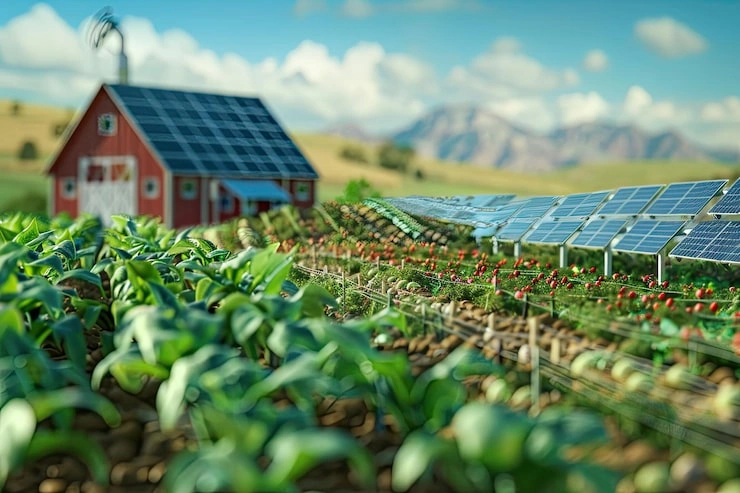
Agrivoltaics Farming With Solar Panels
India is at a turning point. The country needs more power to run its growing economy. The country also needs more food to feed its growing people. Both needs are pressing. Both needs are real. But both needs compete for the same thing: land. This is where agrivoltaics comes in. It is a simple idea with big results. Put solar panels on farmland. Grow crops underneath. Generate power and grow food on the same land. This is not just a dream. It is happening right now across India. From Gujarat to Bihar, farmers are trying this method. The early results are encouraging. This article will explain what agrivoltaics is, how it works in India, what benefits it brings, what challenges it faces, and what the future holds for this agrivoltaics farming with solar panels.
What is Agrivoltaics?
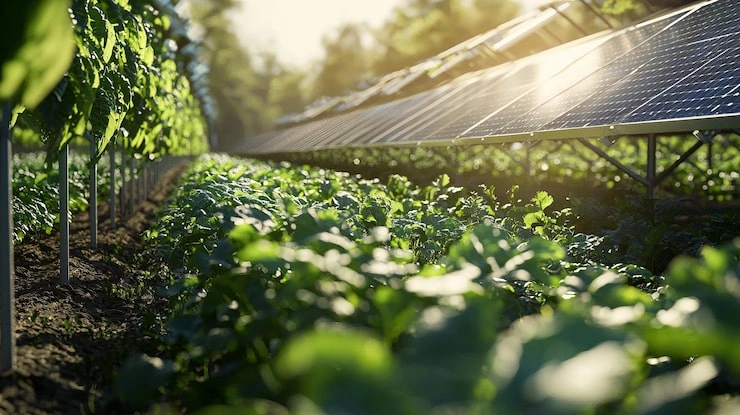
Agrivoltaics is the practice of using the same land for both farming and solar power generation . The word combines "agriculture" and "photovoltaics." Photovoltaics is the technical term for solar panels that turn sunlight into electricity. In an agrivoltaics system, solar panels are raised high enough so that farming can continue underneath them . The panels are placed on tall structures. This leaves enough room for farmers to work, for tractors to move, and for crops to grow .
This is different from regular solar farms. In a regular solar farm, the land is used only for making power. The land cannot be used for anything else. In an agrivoltaics system, the land serves two purposes at the same time. This is called dual-use farming .
The idea is not new. The concept was first introduced in 1982 . But it has gained real traction only in the last ten years. In 2012, there were only 5 megawatts of agrivoltaics installations worldwide. By 2021, that number had grown to over 14 gigawatts . Countries like Japan, China, Germany, France, and the United States have been early leaders in this field . India is now catching up.
Read Also: Government Subsidy For Solar Panels
The Indian Context: Why Agrivoltaics Matters Here
India has a unique set of challenges that make agrivoltaics particularly attractive. First, India is the third-largest energy consumer in the world . The demand for electricity is growing at about six percent every year . At the same time, India relies on imports for about 40 percent of its primary energy needs . This is not a good position to be in. It makes the country vulnerable to global price shocks.
Second, India is the world's third-largest carbon dioxide emitter . The country has made big commitments to reduce its emissions. The government has set a target of 500 gigawatts of renewable energy capacity by 2030. Of this, 300 gigawatts is expected to come from solar power . As of October 2024, India had 92 gigawatts of solar capacity. This puts India in fourth place globally . But to reach the 300 gigawatt target, the country needs to add a lot of solar capacity very quickly.
Third, India has abundant sunlight. Most parts of the country receive four to seven kilowatt-hours per square meter per day of solar radiation . In places like Rajasthan, the average is even higher. Jodhpur receives about six kilowatt-hours per square meter per day . This is a huge natural resource. It can and should be tapped.
How Agrivoltaics Works in Indian Fields?
The basic idea of agrivoltaics is simple. But the actual implementation needs careful planning. The solar panels need to be placed high enough. The height is usually between one and five meters, depending on the design and the crops being grown . The panels also need to be spaced properly. This allows enough light to reach the crops underneath.
There are different types of agrivoltaics designs in India. Some are overhead systems. In these, the panels are placed on tall stilts. The entire field is covered by panels. But the panels are high enough for people and machines to move underneath. This is the most common design in India .
Some designs are interspace systems. In these, the panels are placed in rows. The crops are grown in the spaces between the rows . This design is simpler and cheaper to install. But it covers less of the land with solar panels.
Some designs are vertical systems. In these, the panels are placed upright, facing east and west. They catch the morning and evening sun. This design allows more light to reach the crops. But it is less common in India .
Some designs use bifacial panels. These panels can catch light from both sides. They are often used in vertical setups . They are more efficient per panel. But they also cost more.
The choice of design depends on many factors. What crops are being grown? What is the local climate? How much money does the farmer have? There is no single best design. What works in Maharashtra may not work in Bihar. The system must be tailored to local conditions .
The Benefits of Agrivoltaics
The benefits of agrivoltaics are many. Some are direct and easy to measure. Others are indirect and show up over time. Let us go through the main benefits.
More Income for Farmers
This is the most important benefit for farmers. Agrivoltaics gives farmers two sources of income from the same land. They earn money from selling their crops. They also earn money from selling electricity . This is a powerful combination. Farming is a risky business. The weather is unpredictable. Market prices can crash. A bad harvest can wipe out a farmer's income for the whole year. A steady income from selling electricity provides a safety net. It helps farmers survive the bad years.
The government's PM-KUSUM scheme is designed to make this possible. Under this scheme, farmers can install solar plants of 0.5 to 2 megawatts on their land. They can then sell the power to the electricity distribution companies . The scheme has the potential to be a game-changer. But it has not been fully successful yet. More on this later.
Better Land Use
A regular solar farm uses one piece of land for power. A regular farm uses another piece of land for food. Agrivoltaics uses one piece of land for both. This is called higher land productivity. It is measured using something called the Land Equivalent Ratio. If the Land Equivalent Ratio is more than one, it means the land is being used more efficiently . Research shows that agrivoltaics systems typically have a Land Equivalent Ratio between 1.2 and 1.6 . This means that one hectare of agrivoltaics land produces the equivalent of 1.2 to 1.6 hectares of single-use land. This is a big gain in efficiency. In a country like India, where land is scarce, this matters a lot.
Water Savings
This is one of the most surprising benefits of agrivoltaics. The shade from the solar panels reduces evaporation from the soil . This means less water is needed for irrigation. Research has shown that agrivoltaics can improve water use efficiency by 20 to 47 percent . In some designs, the improvement is even higher. A technology developed by CSIR–National Institute for Interdisciplinary Science and Technology claims to improve water use efficiency by 1.8 to 2.9 times compared to open-field farming . In a water-scarce country like India, this is a very big deal.
Better Crop Growth
This may sound counter-intuitive. Crops need sunlight to grow. How can putting them in the shade help? The answer is that crops do not need all the sunlight that falls on them. In fact, too much sunlight can be harmful. In the middle of the day, when the sun is strongest, many plants experience "midday depression." Their photosynthesis slows down or stops . They are basically taking a break to avoid getting cooked by the sun.
Agrivoltaics prevents this. The solar panels provide shade during the hottest part of the day. This lowers the temperature under the panels. It also increases the humidity. The crops can keep photosynthesizing for longer. Research has shown that agrivoltaics can reduce air temperatures by one to four degrees Celsius . It can also reduce the vapor pressure deficit, which is a measure of how dry the air is . This creates a much better environment for plant growth.
The results are impressive. In a study, cherry tomatoes grown under solar panels had double the yield of tomatoes grown in full sun . Basils and beans also performed well . Other crops that have shown good results in agrivoltaics include leafy greens, turmeric, ginger, berries, and some types of root vegetables . The shade also protects crops from extreme weather like hail, heavy rain, and frost .
Environmental Benefits
Agrivoltaics has a lower environmental impact than regular solar farms. It does not take land out of agricultural use. It reduces the need for water, which is a scarce resource. It generates clean, renewable energy, which reduces greenhouse gas emissions. It can also improve soil health. The shade from the panels reduces soil erosion and helps retain moisture . Some designs even allow for rainwater harvesting .
Other Benefits
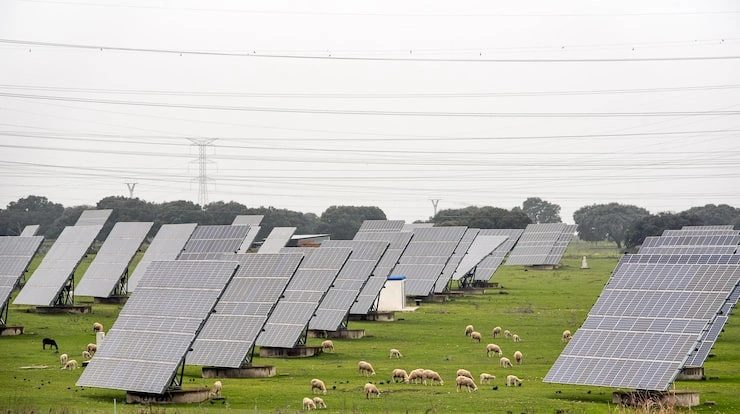
Agrivoltaics can also provide shade for livestock. Farmers can raise sheep or other animals under the panels . The animals keep the grass trimmed. The panels provide them with shade from the sun. This is called agrivoltaics for livestock. It is another way to get more out of the same piece of land.
The Challenges Facing Agrivoltaics in India
The benefits of agrivoltaics are clear. But the adoption of this technology in India has been slow. There are many reasons for this. Let us look at the main challenges.
The High Upfront Cost
This is the biggest barrier. Installing solar panels on tall structures is expensive. It costs 15 to 25 percent more than installing a regular ground-mounted solar system . For a small farmer, this is a huge investment. The average cost of a solar project under the PM-KUSUM scheme is about 40 million rupees per megawatt . Most farmers cannot afford this. Even with government subsidies, the upfront cost is daunting. Banks are also hesitant to lend money for such projects. They see them as risky . About three-fourths of KUSUM-A projects are stalled because of loan delays .
Land Ownership and Fragmentation
Most Indian farmers have very small land holdings. The average size of a farm in India is about 1.1 hectares. To install a solar plant under the PM-KUSUM scheme, a farmer needs at least four acres of land . Most farmers simply do not have that much land. Even if they do, the land may not be suitable. It may not be close to a substation. It may not have good access to roads. These things matter for connecting the solar system to the grid . Fragmented land holdings also make it hard. If a farmer has land in several different places, installing a solar system on one piece may not be worth the trouble.
Crop Selection
Not all crops can grow well under solar panels. The shade from the panels can reduce sunlight by up to 30 percent . This is fine for some crops. Turmeric, ginger, leafy greens, and some berries actually prefer partial shade . But staple crops like wheat and rice need full sun . They do not grow well under panels. This means agrivoltaics is not a solution for all farmers. It works best for farmers who grow high-value, shade-tolerant crops.
Farming Operations
The solar panels get in the way of farming operations. It is harder to use large tractors and other machinery under the panels . Farmers have to be more careful. This can make the work slower and harder. It can also increase the cost of labor. In some cases, the panels have to be placed high enough for machinery to pass underneath. This adds to the cost .
Regulatory and Policy Hurdles
The rules around agrivoltaics are not clear. Land is a subject that is handled by both the central and state governments. This creates confusion . Some states consider agrivoltaics land to be agricultural land. Other states do not. This affects the kind of permissions that are needed. It also affects the taxes that are charged. The lack of a clear national policy framework is a big problem . There is also the issue of net metering. Some states do not allow farmers to sell excess power back to the grid . This takes away a major incentive for farmers.
Knowledge Gaps
Agrivoltaics is still a new technology. Many farmers have never heard of it. Even if they have, they do not know how to go about it. What kind of panels should they use? What height should they put them at? What crops should they grow? How do they maintain the system? These are all questions that need answers. There is a need for demonstration projects. Farmers need to see agrivoltaics working with their own eyes. There is also a need for training. Agricultural universities and government agencies have a big role to play here.
Read: Solar Panel Efficiency Improvement Techniques In India
Real Stories from the Field
Despite the challenges, there are already many agrivoltaics projects in India. These projects are providing valuable lessons.
Gujarat has been an early leader in agrivoltaics. The Gujarat Industries Power Corporation set up a one megawatt plant in Amrol in 2016 . The plant uses overhead panels at a height of one to three meters. This allows tractors to move underneath. The system also collects rainwater for irrigation. The loamy sand soil in the area is good for farming. The project has shown that farming can continue alongside solar power generation.
In Maharashtra, the Jain Irrigation company set up a project in Jalgaon in 2014 . This is an overhead system with panels at a height of more than five meters. This leaves a lot of room for farming operations. The system uses transparent panels in a greenhouse. This creates the best possible conditions for the crops. But it also costs a lot of money. The project shows what is possible with the right technology and agrivoltaics farming with solar panels.
In Rajasthan, the Central Arid Zone Research Institute in Jodhpur set up a project in 2017 . This is an interspace design. The panels are placed in rows. The crops are grown in the spaces between them. The system collects rainwater for irrigation. The project has shown that mung bean can be grown without much effect from the shade. Aloe vera also thrives under the panels. But some other crops like moth bean and cumin are affected.
In Bihar, the Tata-Cornell Institute has set up a community agrivoltaics project in Nawada . This is a different model. Instead of one farmer, a group of farmers has come together. They formed a producer group. They invested in the project together. Their eight acres of farmland are now being used more efficiently. They have switched to drip irrigation. They are growing a wider variety of crops. They are also using the excess power for food processing. They are making flour. They are charging electric vehicles. This community model is a great example of how agrivoltaics can be adapted for small farmers.
In Kerala, the Cochin International Airport has a four megawatt solar project that also uses the land for farming . The airport produces 60 to 80 tons of organic vegetables every year from the land under its solar panels. This is a wonderful example of how even large industrial installations can be used for farming.
The Role of Government and Policy
The Indian government has taken some important steps. The PM-KUSUM scheme is a big one. It provides subsidies for farmers to install solar pumps and solar plants. But the scheme has not been fully successful. The adoption of agrivoltaics under the scheme has been very limited .
The government has signaled that it will launch a KUSUM 2.0 scheme . This is a chance to fix the problems. Experts have made several recommendations. The scheme should explicitly support agrivoltaics. It should recognize agrivoltaics land as agricultural land. This would make it easier for farmers to get permissions and loans . The scheme should also provide more financial support for small and marginal farmers. They could be supported through farmer producer organizations . These organizations can pool land and resources. They can negotiate better rates for loans and power sales.
There is also a need for a clear national policy framework on agrivoltaics . This framework should cover system design, technology selection, financing, and implementation. It should also set up a mechanism for collecting and analyzing data. This data is essential for improving the technology and making better policies .
The Future of Agrivoltaics in India
The potential of agrivoltaics in India is enormous. The Energy and Resources Institute has estimated that the potential for horticulture, tea, and coffee crops alone is 4.7 terawatts . A GIZ India report puts the technical potential even higher, between 3,156 and 13,803 gigawatts . This is a huge opportunity.
But the future depends on how well we address the challenges. The cost of solar panels is coming down. This will help. New technologies are also being developed. The CSIR–National Institute for Interdisciplinary Science and Technology has developed a system called Even Solar Sharing Agrivoltaics . This technology uses special optics to spread the sunlight more evenly. It also converts some of the light from green to red. This improves the quality of light for the plants. The technology has been validated in field trials. It is now ready for commercial deployment .
There is also a growing awareness of the benefits of agrivoltaics. Farmers are starting to see the value. Policymakers are starting to take notice. The key is to make the economics work for small farmers. This means providing better financing, clearer policies, and more technical support.
Agrivoltaics is not a magic solution. It will not solve all our problems. But it can be a significant part of the solution. It can help us produce more food. It can help us generate more clean energy. It can help us use our water more efficiently. It can help us fight climate change. Most importantly, it can improve the lives of millions of Indian farmers. It can give them a more stable income. It can help them adapt to climate change. It can make their farms more productive and more sustainable.
The sun shines on India's fields every day. That sunlight can be used for more than just growing crops. It can also be turned into electricity. Agrivoltaics allows us to do both. It allows us to harvest the sun twice. This is a smart way to farm. It is also a smart way to think about our future. The potential is there. The need is there. Now we need to make it happen.